
Real Estate Professional Status vs. the Short-Term Rental Loophole: What Every Investor Needs to Know
Introduction
If you’re investing in real estate, you’ve probably heard about two powerful tax strategies: Real Estate Professional Status (REPS) and the “short-term rental loophole.” Both can unlock major tax benefits—but they work very differently, and choosing the right path can mean the difference between thousands saved or thousands lost. Let’s break down what each strategy means, who qualifies, and how to make the most of your real estate investments.
What is Real Estate Professional Status (REPS)?
Real Estate Professional Status is a special IRS classification that allows certain taxpayers to treat rental losses as non-passive, meaning you can use those losses to offset other income (like W-2 wages or business income).
Key Requirements:
- You must spend more than 750 hours per year in real estate trades or businesses in which you materially participate.
- More than 50% of your personal service time must be in real estate activities.
- Material participation in each property or group of properties is required.
Why It Matters:
Normally, rental real estate losses are considered “passive” and can only offset other passive income. With REPS, you can use those losses to reduce your overall tax bill—even against your salary or business profits.
What is the Short-Term Rental (STR) Loophole?
The “short-term rental loophole” refers to a unique exception in IRS rules that allows certain short-term rental activities (like Airbnb or VRBO properties) to generate non-passive losses—even if you don’t qualify as a real estate professional.
Key Requirements:
- The average rental period for guests must be 7 days or less (or 30 days or less if significant personal services are provided).
- You must materially participate in the rental activity—commonly, investors meet this by spending at least 100 hours per year and more than anyone else on the property’s operations. This includes tasks like guest communication, cleaning, maintenance, and marketing.
Why It Matters:
If you actively manage a short-term rental, you can potentially use losses (for example, from cost segregation or bonus depreciation) to offset your other income—even if you have a full-time job outside of real estate.
Side-by-Side Comparison
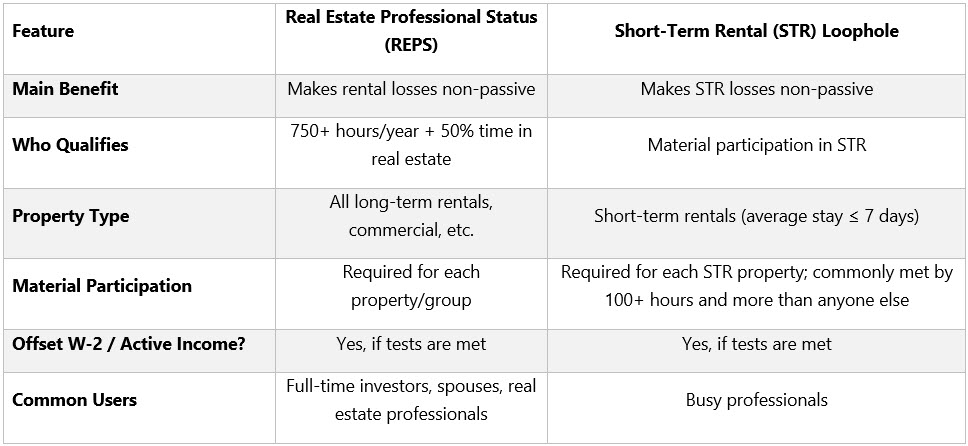
Which Strategy is Right for You?
- REPS is ideal if real estate is your main gig or you have a spouse who can qualify.
- STR Loophole is great for high-income professionals who want to use rental losses but don’t have time to meet REPS requirements.
Both strategies require careful planning, documentation, and ongoing compliance. The IRS scrutinizes these claims—so it’s critical to get expert advice and keep detailed records.
How Tarantino CPA Helps Investors Succeed
At Tarantino CPA, we specialize in advanced tax strategies for real estate investors. Here’s how we help you:
- Qualification Analysis: We review your situation to determine if you can achieve REPS or leverage the STR loophole.
- Entity Structuring: Guidance on LLCs, S-Corps, and partnerships for the best tax outcome.
- Cost Segregation Studies: Accelerate depreciation to maximize losses and reduce taxable income.
- Ongoing Support: Year-round advice, audit defense, and proactive tax planning.
Real-World Example
A recent client, a physician earning $400,000 annually, wanted to reduce their sizable tax bill. They purchased a short-term rental property and, by materially participating—spending over 100 hours in a year and more than anyone else managing the property—they were able to claim significant bonus depreciation. This resulted in over $80,000 in non-passive losses, which directly offset their W-2 income for the year, saving them more than $30,000 in taxes—all without needing to qualify for Real Estate Professional Status.
FAQs: Real Estate Professional Status & Short-Term Rental Loophole
Q: If I qualify for REPS, do I still need to materially participate in each property?
A: Yes. Both the 750-hour/50% tests and material participation are required for each property or group.
Q: Can my spouse qualify for REPS if I have a full-time job?
A: Yes! If you file jointly, your spouse’s hours can help you qualify—even if you’re busy with other work.
Q: What counts as “material participation” for STRs?
A: Activities like guest communication, cleaning, maintenance, and marketing. Commonly, investors meet the requirement by spending at least 100 hours annually and more than anyone else on the property.
Q: Can I use both strategies at once?
A: You can’t double-dip on the same property, but you can have different properties using different strategies.
Q: What happens if I don’t qualify for either?
A: Your rental losses are likely passive and can only offset passive income (or be carried forward).
Q: How do I prove my hours and participation?
A: Keep contemporaneous logs, calendars, emails, and receipts. The IRS often asks for proof.
Q: Is cost segregation or bonus depreciation available for both?
A: Yes! Both REPS and STR investors can benefit from accelerated depreciation to create larger losses.
Q: What’s the first step to see which strategy fits me?
A: Book a consultation with Tarantino CPA. We’ll analyze your situation, explain your options, and create a custom tax plan.
Ready to Maximize Your Real Estate Tax Savings?
Whether you’re a full-time investor or a busy professional, smart tax planning can help you legally reduce your tax bill and maximize your real estate returns.
📋 Fill out the form to get started with a personalized tax plan from Tarantino CPA today.


